 Atlacare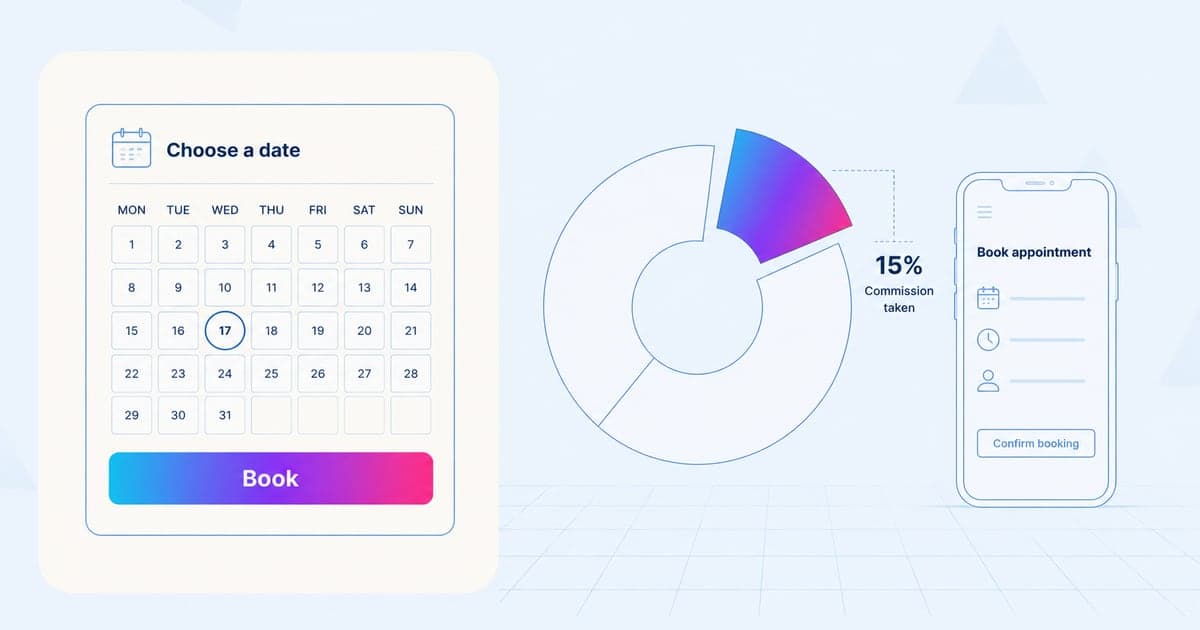
Commission-based booking marketplaces make an attractive offer to a new clinic: we only get paid when you do. With an empty diary and no reputation, that is a genuinely reasonable trade, and anyone who tells you otherwise is selling something.
The problem is not the offer. It is that the offer never expires.
What commission actually costs
Two platforms dominate UK consumer bookings for treatment businesses, and their terms differ considerably.
Fresha charges up to 20% of the appointment value on new clients acquired through its marketplace, with a minimum of around £6. On top of that: £14.95 a month for a solo professional, or £9.95 per team member with a two-person minimum, card fees of 1.40% + 25p online and 1.19% + 20p in person, and SMS at 5p after a free allowance of 20 per staff member per month.
Treatwell charges 35% plus VAT on new-client marketplace bookings.
Neither charges commission on returning clients, which is the most important thing to understand about the model and the part critics usually skip. This is an acquisition fee, not a levy on your practice.
So price the acquisition. The median UK physiotherapy initial assessment is £74, according to the UK Private Practice Barometer 2026, a survey of 715 clinic owners.
| Platform | Commission on a £74 initial |
|---|---|
| Fresha | about £14.80 |
| Treatwell | about £25.90 plus VAT |
Now compare that to what acquiring a patient actually costs. The same survey puts median cost per patient acquisition at £25.
Fresha's £14.80 is below the market cost of acquiring a patient. On those numbers it is a good deal, and we are not going to pretend otherwise. Treatwell's £25.90 plus VAT is above it, before you have paid for anything else.
There is a wrinkle that makes the comparison less flattering than it looks, though. Only 25.8% of clinic owners track their acquisition cost at all, and those who do report median revenue of £327,500 against £200,000 for those who do not. If you do not know your CAC, you cannot tell whether the commission is cheap or expensive, and you will not notice when it changes.
The argument that is not about arithmetic
Run the commission long enough and it stops being an acquisition cost, because you stop being able to tell which patients you acquired.
A patient who books through a marketplace has a relationship with the marketplace. They downloaded it, they browse it, and the next time their back goes they open it again rather than searching for you. Depending on the platform, you may not own their contact details outright, and you are certainly not the only clinic being shown to them.
A patient who books on your own page, from your own website, is entirely yours. Their repeat visits, which in physiotherapy happen 73.3% of the time according to the Barometer, cost you nothing on either model. But their next episode of care, eighteen months later, comes back to whoever they think of as their physio.
That is the real question. Not what the 20% costs this year, but who the patient belongs to in three years.
What your own booking page has to do
If you are going to run booking yourself, it has to be at least as good as the marketplace, or patients will simply ring instead and you will have gained nothing but admin.
It must work on a phone. Most bookings happen on mobile, often in the evening. If your booking page requires pinching and zooming, you have built a phone-call generator.
It must show real availability. Pulled live from your actual diary, respecting your working hours, your clinic's opening times, and your closures. A booking page showing slots you cannot honour is worse than no booking page.
It must not double-book. This is the part people underestimate. Two patients on the page at the same time, both looking at Tuesday at 2pm, is a race. Proper systems lock the slot while someone completes their details. Atlacare holds the slot for ten minutes with a lock token, then releases it if the booking is not completed, which means the slot is neither double-taken nor lost.
It must confirm immediately. An automatic confirmation email, and a text if you have SMS enabled. Patients who do not get a confirmation ring to check, which defeats the point.
It must not be a form that emails you. A booking request is not a booking. If a human has to read it and reply, you have built a slower version of the telephone.
It should collect what you need up front. Name, contact details, and the consent capture you need for UK GDPR. Doing this at booking rather than in the waiting room saves five minutes of every first appointment.
Getting found without a marketplace
This is the part the marketplace was actually selling you, and it is fair to ask what replaces it.
Google Business Profile is the workhorse. For a local health service it does more early work than a website. Claim it, complete it properly, pick your categories carefully, add photographs of the actual treatment room, keep opening hours current, and put your booking link on it. Patients searching "physio near me" are looking at a map, not at page one of the blue links.
Reviews compound. Ask every discharged patient who got better. A steady flow of recent reviews moves you up the local map pack and does more for conversion than any amount of copy on your homepage.
Your own clinic page needs to exist. Not a brochure nobody updates: a page with your services, your prices, your team, and a booking button that works. Atlacare includes a full public clinic page on every plan, including the free one, with booking built into it, structured data for search engines, and a contact form that lands in your inbox rather than exposing your email address. That exists because for a lot of solo practitioners, paying a web designer £1,500 before seeing a single patient is the thing that stops them starting.
Referrals still matter, slowly. GPs, consultants, local gyms and running clubs build over months rather than days. They are the cheapest patients you will ever get and the slowest to arrive, which is exactly why the marketplace offer is tempting in month one.
When a marketplace is the right answer
Honestly:
- You are opening cold, with no reputation, no reviews and no referrers. Paying 20% on the first visit of patients you would not otherwise have seen is a rational way to start
- You have persistent unsold capacity at specific times, and marginal revenue on an otherwise empty Tuesday morning beats an empty Tuesday morning
- You do not want to run any of this yourself, and the commission is worth not thinking about it
What tends to go wrong is drift. The clinic that joined for acquisition in year one is still paying acquisition rates in year four on patients who would have found them anyway. If you use a marketplace, track what share of new patients it actually brings, and check it every six months against that £25 median.
A sensible sequence
- Get your own booking page live first, whatever else you do. It costs a fraction of a single month's commission and it is the asset you keep
- Claim and complete your Google Business Profile, and point it at your booking page
- Ask for reviews from every patient who finishes a course of treatment
- Then, if the diary is still thin, add a marketplace deliberately, for acquisition, with a number in mind for what a new patient is worth to you
- Review it twice a year against what you are actually paying per new patient
The order matters. A marketplace added on top of your own booking page is an acquisition channel. A marketplace used instead of your own booking page is a landlord.
Sources: UK Private Practice Barometer 2026 (HMDG, 715 UK clinic owners, surveyed August to November 2025) for fee, acquisition cost and rebooking benchmarks, all self-reported. Platform pricing as published by Fresha and Treatwell at the time of writing; verify current rates before deciding, as commission terms change.
Related: How much should a physiotherapy session cost in the UK? · How to reduce no-shows at your physio clinic