 Atlacare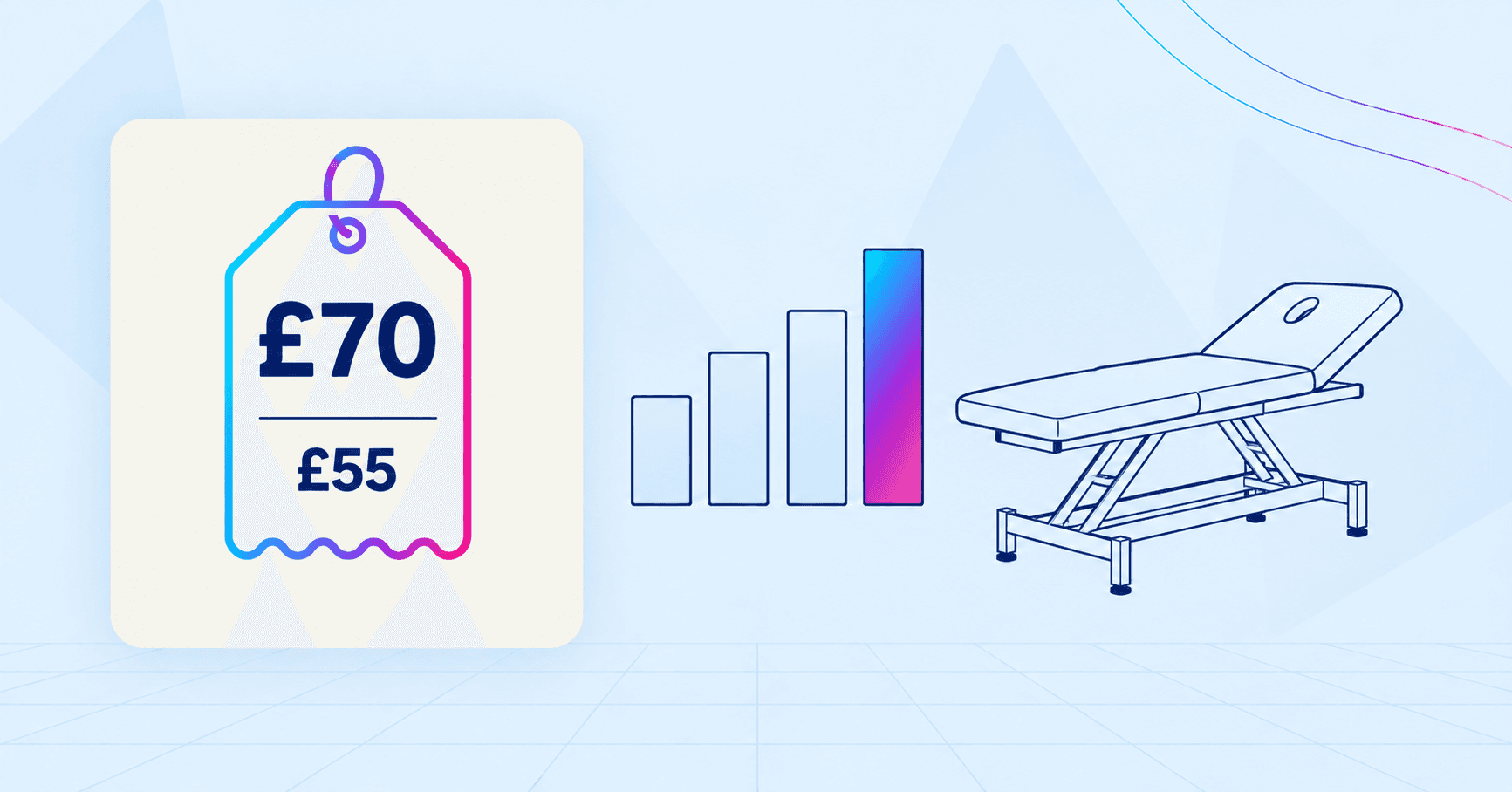
UK osteopaths charge a median of £70 for an initial appointment and £55 for a follow-up. That is from the only independent benchmarking survey the sector has, and it puts osteopathy below physiotherapy on both.
Search this question and you will find price guides written for patients: what to expect to pay, how much a session costs, why London is dearer. Almost nothing addresses the practitioner deciding what to charge, which is a different question with a different answer.
What does the survey say?
The UK Private Practice Barometer 2026 surveyed 715 UK clinic owners between August and November 2025. Osteopathy medians:
| Initial | Follow-up | |
|---|---|---|
| Osteopathy | £70 | £55 |
| Physiotherapy | £74 | £63 |
| Podiatry | £81 | £61 |
| Chiropractic | £69 | £47 |
Two caveats. The osteopathy sample is 64 clinics, which is small, so treat it as a solid indication rather than a precise figure. And it is self-reported.
The comparison is the interesting part. Osteopathy sits £4 below physiotherapy on the initial and £8 below on the follow-up, and the follow-up gap matters far more because that is where the volume is. Over a five-session episode of care, that £8 compounds into £32 per patient against a physiotherapist doing broadly comparable musculoskeletal work.
What do published prices show?
Wider than the medians, as you would expect from advertised rates rather than survey responses.
Clinic price pages cluster around £50 to £75 for a follow-up, with initial appointments £60 to £120. Central London and Harley Street run £120 to £180. Rural practices sit at £40 to £60. Student clinics, where treatment is supervised, are typically £20 to £40.
Your region matters more than the national figure. Benchmarking a Yorkshire practice against a London median is not useful information.
What does it cost you to deliver?
This is where the practitioner question diverges from the patient one, and where honest figures are hard to come by.
Indicative costs from commercial sources, which are not survey data and should be treated as ballpark: indemnity in the region of £400 to £800 a year, clinic room rent anywhere from £500 to £2,000 a month depending on location and arrangement, and overheads consuming something in the order of 40 to 50% of the fee once everything is counted.
On GOsC registration specifically, we found conflicting figures in circulation and no authoritative primary source, so we are not going to publish one. Take that number from the GOsC directly.
The Barometer's cross-discipline figures give firmer ground: median profit margin across UK private practice is about 20%, and average diary utilisation is 72.3%. Both of those matter more to your income than your headline fee, which brings us to the point.
Your fee is not the biggest lever
The survey data on this is consistent across disciplines and it surprises people.
Sessions per episode of care. Median 5.0, with the top decile reaching 8 or more. Three additional sessions at £55 is £165 per patient, with no acquisition cost attached, because they are already your patient.
Rebooking rate. Average 74%, median 80%, top 10% above 90%.
Utilisation. 72.3% on average, meaning roughly a quarter of your bookable time is empty.
Price. Real, but third or fourth on this list.
An osteopath moving from 5.0 to 6.5 sessions per episode across 100 patients a year gains more than one charging £5 more per session. And unlike a price rise, nobody has to be told.
Should you raise your prices?
Probably, and the survey suggests most of the market already has. 73.5% of clinics raised prices in the twelve months to November 2025, and 66% planned to again, with a median planned rise of 6%.
If you have not moved your fee in two years, you have taken a real-terms cut while three quarters of your market did not.
Practical points if you do:
Move the follow-up, not just the initial. Follow-ups are most of your appointments and most of your income. That £8 gap against physiotherapy sits on the line that matters.
Give notice, thirty days, in writing, to existing patients.
Do it annually, on a schedule. Predictable small rises are easier to absorb and to explain than an occasional large one.
Do not over-explain. A single plain sentence lands better than a paragraph of justification, which invites a negotiation.
What about insurer work?
A separate calculation, and one worth doing before you assume it is worth having.
Insurer-recognised work brings volume and predictability, and it comes with fee schedules set by the insurer rather than by you. Our guide to insurer recognition for osteopaths covers the terms, including one that materially affects the economics: some networks prohibit you from billing the patient for any shortfall between their fee and yours.
That makes the insurer rate your rate for those patients, not a floor you can build on.
Where to start
- Find your regional benchmark, not the national median
- Compare your follow-up fee, not your initial, because that is where the money is
- Work out your sessions per episode before you touch the price list
- Set a review date so the fee moves annually rather than occasionally
- Check your insurer positions, since those fees may not be yours to set
The honest summary is that osteopathy prices a little below physiotherapy for similar work, most noticeably on follow-ups, and that the profession's pricing conversation is largely happening in public pages written for patients. Knowing the practitioner numbers is a small advantage that very few of your competitors have.
Figures are from a self-reported survey of clinic owners and from published clinic price pages, not audited accounts. The osteopathy sample is 64 clinics. Cost estimates are indicative and drawn from commercial sources. Confirm registration and indemnity costs directly with the relevant bodies.
Sources: UK Private Practice Barometer 2026 · General Osteopathic Council
Related: Do private insurers cover osteopathy? · What can osteopaths claim in advertising? · Practice management software for osteopaths