 Atlacare
A private physiotherapy session in the UK costs a median of £74 for an initial assessment and £63 for a follow-up in 2026, ranging from £84.22 in London to £54.20 in Northern Ireland.
Until this year, nobody could give you that answer properly.
Ask what a physio session costs in the UK and you get a clinic quoting its own price list, which tells you what one practice charges and nothing about the market. In March 2026 that changed. HMDG published the UK Private Practice Barometer, the first independent benchmarking survey of the UK musculoskeletal industry: 715 clinic owners surveyed between August and November 2025, with 336 clinics supplying valid fee data and physiotherapy the largest specialty in the sample at 233 responses.
It is self-reported survey data rather than audited accounts, so treat it as a well-drawn map rather than a satellite photograph. It is still far better than anything the profession had before.
This guide covers both halves of the question. If you are a patient, the first section tells you what to expect to pay. If you are a practitioner, everything after that is about turning a fee into an income, which is a different problem and the one that actually matters.
What do UK physiotherapists charge in 2026?
UK physiotherapists charge a median of £74 for an initial assessment and £63 for a follow-up appointment, according to the Private Practice Barometer 2026 survey of 715 clinic owners.
That national figure hides a lot of geography.
| Region | Initial assessment | Follow-up | vs national |
|---|---|---|---|
| London | £84.22 | £62.15 | +21.3% |
| South East | £71.45 | £54.30 | +2.9% |
| East of England | £68.90 | £52.10 | −0.8% |
| South West | £66.12 | £50.85 | −4.8% |
| West Midlands | £64.50 | £49.20 | −7.1% |
| North West | £63.15 | £48.75 | −9.1% |
| Scotland | £60.90 | £47.20 | −12.3% |
| Wales | £58.40 | £45.10 | −15.9% |
| Northern Ireland | £54.20 | £42.50 | −22.0% |
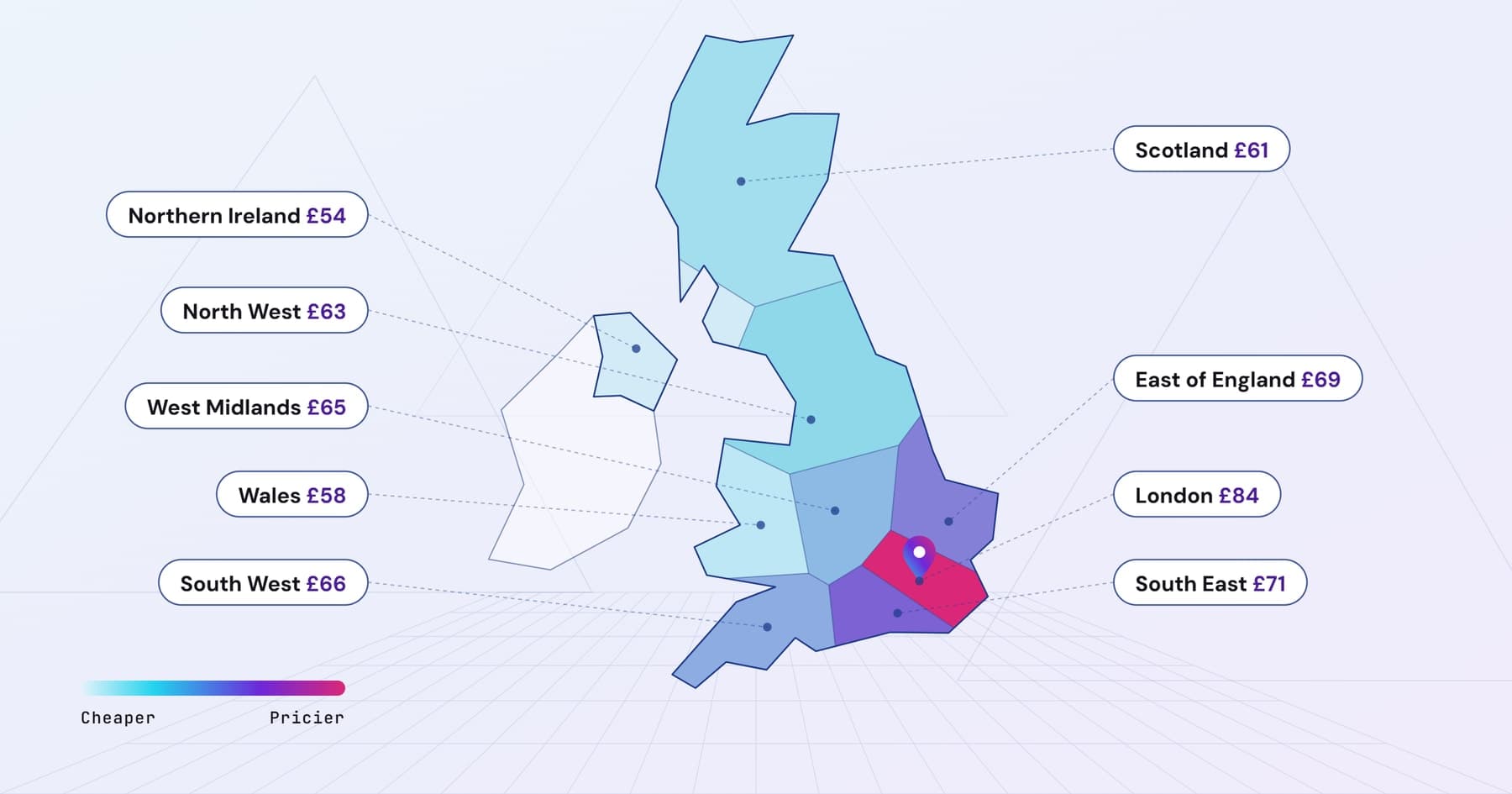
A London initial assessment costs 55% more than one in Belfast. If you are benchmarking your own fee, the national median is close to useless. Your region is the number that matters.
It also varies by discipline, which is worth knowing if you share premises with other practitioners or are deciding what to add to your service list.
| Specialty | Initial | Follow-up | Sample |
|---|---|---|---|
| Podiatry | £81 | £61 | 77 |
| Physiotherapy | £74 | £63 | 233 |
| Osteopathy | £70 | £55 | 64 |
| Chiropractic | £69 | £47 | 54 |
| Pilates (1:1) | £55 | £55 | 73 |
| Strength & conditioning | £55 | £45 | 78 |
Physiotherapy has the highest follow-up fee of any discipline in the survey, including podiatry, which charges more up front. That is worth sitting with: the physio follow-up is the most valuable repeat appointment in UK musculoskeletal practice, and as the next section shows, repeat appointments are where the money actually is.
Are UK physiotherapy clinics putting their prices up?
Yes, and almost all of them. 73.5% of UK private practice clinics raised their prices in the 12 months to November 2025, and 66% plan to raise them again in the following 12 months. The average planned increase is 7.8%, with a median of 6%.
Clinics turning over more than £1M charge £80 initial and £65 follow-up, against £70 and £55 for everyone else, and 88% of them raised prices last year. Whether higher prices produce bigger clinics or bigger clinics feel able to charge more, the two travel together.
The practical implication is uncomfortable. If you have not raised your fee in a year, you have not held your position, you have moved backwards relative to three quarters of your market.
Should you charge more for an initial assessment?
81.6% of UK clinics charge more for an initial assessment than for a follow-up appointment. It is close to a professional convention: the first appointment is longer, involves a full subjective and objective assessment, and produces a treatment plan, so it costs more.
The Private Practice Barometer found the opposite of what that convention assumes. Clinics charging the same as or less than their follow-up fee for an initial assessment reported a 10.2% drop-off after session one, against 14.4% for clinics charging an initial premium.
Think about what a premium initial fee does. It puts your highest price in front of the person with the least reason to trust you, at the exact moment they are deciding whether physiotherapy is worth it at all. They have not felt better yet. They have nothing to weigh the cost against.
Run it on the numbers below. On a median caseload, four points of extra drop-off after session one is worth considerably more than the ten or fifteen pounds of premium on the initial. If your first appointment genuinely takes ninety minutes, charge for ninety minutes. But if the premium is there because everyone else does it, it may be an expensive habit.
How do you turn a session fee into an actual income?
Here is where most pricing advice stops and where the interesting part starts. Your fee is one of five inputs, and it is not the most powerful one.
The arithmetic:
Weekly gross     = sessions per week x average fee
Realised weekly  = weekly gross x (1 - DNA rate)
Annual gross     = realised weekly x working weeks
Take-home        = annual gross x margin
Now populate it with real benchmarks rather than optimistic ones.
Sessions per week. Diary utilisation is the percentage of your bookable appointment slots that are actually filled, and the UK average is 72.3%. If you have 28 bookable slots, you are realistically filling around 20. Assume a full diary and every number that follows will be wrong.
Average fee. Use your regional follow-up figure from the table above, not the initial. Most of your appointments are follow-ups. We will use the £63 national median.
DNA rate. DNA stands for "did not attend" and is the percentage of booked appointments where the patient neither attends nor cancels. UK clinics running appointment reminders average 6.3%; those that do not average 7 to 8%.
Working weeks. Six weeks off gives you 46. Be honest here: 39% of owners in the survey report not taking adequate leave, which is a burnout statistic, not a business strategy.
Margin. Median profit margin across the survey is about 20% after room rent, insurance, software, admin and everything else.
Putting it together:
- 20 sessions a week at £63 = £1,260 gross a week
- Less 6.3% DNA = £1,181 realised
- Over 46 working weeks = £54,300 a year
20 sessions a week × £63 × 46 working weeks
less £3,660 to a 6.3% did-not-attend rate
less ~£18,300 running costs: rooms, insurance, software, admin
Sanity check: the Barometer reports median owner earnings of £50,000, with solo operators doing more than 90% clinical work on £36,000. Our model lands in the right postcode, which suggests the inputs are sound.
That gap between £54,300 realised and £36,000 taken home by the median solo operator is the entire cost of running a practice. It is not a rounding error.
Work out your own number
Drag the sliders to your reality. The take-home updates as you go.
Weekly gross
£1,260
Realised a year
£54,309
Running costs
−£18,000
Your take-home
£36,309
This calculator runs entirely in your browser. Nothing you type is sent anywhere, saved, or recorded.
The five levers, ranked
Most practitioners reach for price first. On the numbers, it is third.
| Rank | Lever | Benchmark move | Worth per year |
|---|---|---|---|
| 1 | Sessions per episode | 5.0 → 8.0 (top decile) | ~£18,900 per 100 patients |
| 2 | Rebooking rate | 74% → 85% | ~£3,400 |
| 3 | Price | +6% (median planned rise) | ~£3,250 |
| 4 | No-show rate | 7.5% → 6.3% | ~£700 |
| 5 | Diary utilisation | 72.3%, capped at 80% | Limited by wait times |
1. Sessions per episode of care. Sessions per episode of care is the number of appointments a single patient attends for one presenting problem, from assessment to discharge. The UK median is 5.0 sessions; the top quartile of clinics reach 6 or more and the top decile 8 or more. Three additional sessions at £63 is £189 per patient, and it costs you nothing in acquisition because they are already in front of you. Across 100 patients a year that is £18,900. Nothing else on this list comes close.
This is a clinical conversation, not a sales one. Patients drop out because they feel better and assume they are done, or because nobody explained what the full course looked like. A treatment plan agreed at assessment, with the number of sessions stated, is the single highest-value administrative act in private practice.
2. Rebooking rate. Rebooking rate is the percentage of patients who book a further appointment rather than dropping out after one. The UK average is 74%, the median 80%, and the top 10% of clinics exceed 90%. In physiotherapy specifically the average is 73.3% and the top decile reach 84.8%. Moving from 74% to 85% across 100 patients a year is eleven extra episodes of care, worth roughly £3,400 at five sessions each.
Notably, price has almost no correlation with rebooking. Clinics charging over £150 retain at 82.5% against 72.3% for those under £50, but the Barometer attributes that to systemisation rather than price. Expensive clinics tend to be organised clinics. It is the organisation doing the work.
3. Price. A 6% increase, the median planned rise, applied to £54,300 is about £3,250 a year for one uncomfortable conversation and a new price list. That is real money and it is why three quarters of the market did it. It is simply not the biggest number on this page.
4. Reducing no-shows. Going from 7.5% to 6.3% is worth roughly £700 a year on this model. Worth doing, largely automatable, and covered properly in our guide to reducing no-shows.
5. Utilisation, with a warning. The Barometer found wait times rise sharply above 80% utilisation: 5.5 days average against 2.6 days at 50 to 70%. A diary that looks efficient at 90% is a diary where new patients cannot get in for a week, and some of them will ring someone else. Full is not the same as optimal.
Why do owners with 2 to 5 staff earn less than solo physiotherapists?
One finding deserves its own heading, because it contradicts the assumption most practitioners make about growth.
Median owner earnings by clinic size, UK private practice, 2026:
| Stage | Median owner earnings |
|---|---|
| Solo (>90% clinical) | £36,000 |
| 2–5 staff | £45,000 |
| 6–10 staff | £60,000 |
| 11+ staff | £82,500 |
| CEO-stage (under 10% of own time clinical) | £71,000 |
CEO-stage is a role rather than a size, which is why it sits outside the sequence: it describes owners who have largely stopped treating, at any clinic size.
Look at the 2–5 staff band. £45,000, for running a business with employees, premises, payroll and management responsibility, against £36,000 for working alone with none of it. Nine thousand pounds for a categorically harder job.
The Private Practice Barometer calls this the Danger Zone. The Danger Zone is the clinic size, typically 2 to 5 staff, at which overhead has arrived but scale has not, so the owner earns less than they would running the practice alone. You take on rooms, admin support and employment liability, and the revenue those staff generate does not yet cover what they cost you in money and attention. It resolves at 6 to 10 staff, where median earnings reach £60,000.
The strategic read is that 2–5 staff is a place to move through deliberately, not to settle in. If you are going to grow, plan for the trough and be capitalised for it. If you are not, staying solo and optimising sessions per episode is a perfectly respectable business.
When should you raise your physiotherapy prices?
Given 73.5% of the market moved last year, the question is mostly when, not whether.
Give notice. Thirty days, in writing, to existing patients. Most practices email it and put a note in the waiting room.
Move the follow-up, not just the initial. Follow-ups are the bulk of your appointments and the bulk of your income. A rise applied only to initial assessments barely moves the annual number and, per the finding above, may cost you retention.
Do it on a schedule. Once a year, same month, is easier to explain and easier to absorb than an unpredictable jump every third year. The Barometer's "serial raisers", clinics that raised last year and plan to again, run at 68%.
Do not announce an apology. A rise explained in one plain sentence lands better than a paragraph of justification, which invites a negotiation you did not intend to open.
Know your number first. Before changing anything, work out what a 6% rise is actually worth to you using the model above. Some practices discover the answer is £3,000 and that a retention conversation is worth £18,000, and they go and fix that instead.
Insurers and self-pay
Most private physiotherapists work a mix of self-pay and insurer-funded patients, and the two behave differently.
Insurer rates are individually negotiated with each provider and are generally below your self-pay fee. The trade is volume and predictability against margin, plus administrative overhead in claims and authorisations. The Barometer does not publish insurer reimbursement rates and we are not going to guess at them, so treat any figure you see quoted online with suspicion and get your rates in writing from the insurer.
What you can control is the admin. Insurance work generates authorisation numbers, session counts against an authorised total, and excess amounts that need collecting from the patient. Tracking that in a notebook is how practices end up delivering sessions nobody is going to pay for. Any decent practice management system, Atlacare included, should hold the authorisation, the sessions authorised, the sessions used and the excess on the patient record so you can see it before you book the appointment, not after.
Where to start
If you take one thing from the survey data, make it this: you are probably underpriced and definitely under-retained. Three quarters of your market raised prices last year, and the difference between a median clinic and a top-decile one is not the fee, it is three more sessions per episode and fifteen more points of rebooking.
So the honest answer to what you should charge for a physiotherapy session in the UK is: your regional median, reviewed annually, and then stop thinking about price and go and look at your rebooking rate.
Work out your own number using the model above. Then decide which lever you are pulling this quarter.
Sources: UK Private Practice Barometer 2026 (HMDG, 715 UK clinic owners, surveyed August to November 2025, published 3 March 2026). All pricing, retention, utilisation, margin and owner earnings figures are drawn from that survey and are self-reported.
Related: How to reduce no-shows at your physio clinic · Practice management software for physiotherapists · Setting up online booking without paying commission