 Atlacare
Radial and focused shockwave are different technologies, not price tiers. Radial delivers maximum pressure at the applicator and attenuates with depth, reaching around 3 to 4cm. Focused converges energy at a point up to 10 to 12cm down. Most physiotherapy clinics buy radial, most suppliers describe both as "shockwave", and the word covers two machines that do different jobs at very different prices.
This is the technical and commercial brief, including the two costs suppliers do not put in the quote.
How do the two technologies actually differ?
By where the energy ends up.
Focused shockwave (F-SWT) generates a wide pressure field that converges at a defined focal depth inside the tissue. Because the energy concentrates rather than disperses, it can act on structures well below the surface.
Radial shockwave (R-SWT) exerts its maximum pressure at the applicator itself and attenuates as the wave travels inward. The peer-reviewed position is blunter than the marketing: radial waves reach lower speeds, generate lower peak pressures, and may not generate a true shockwave at all in the physical sense.
That is not a reason to dismiss radial. It is a reason to be precise about what you are buying and what you tell patients.
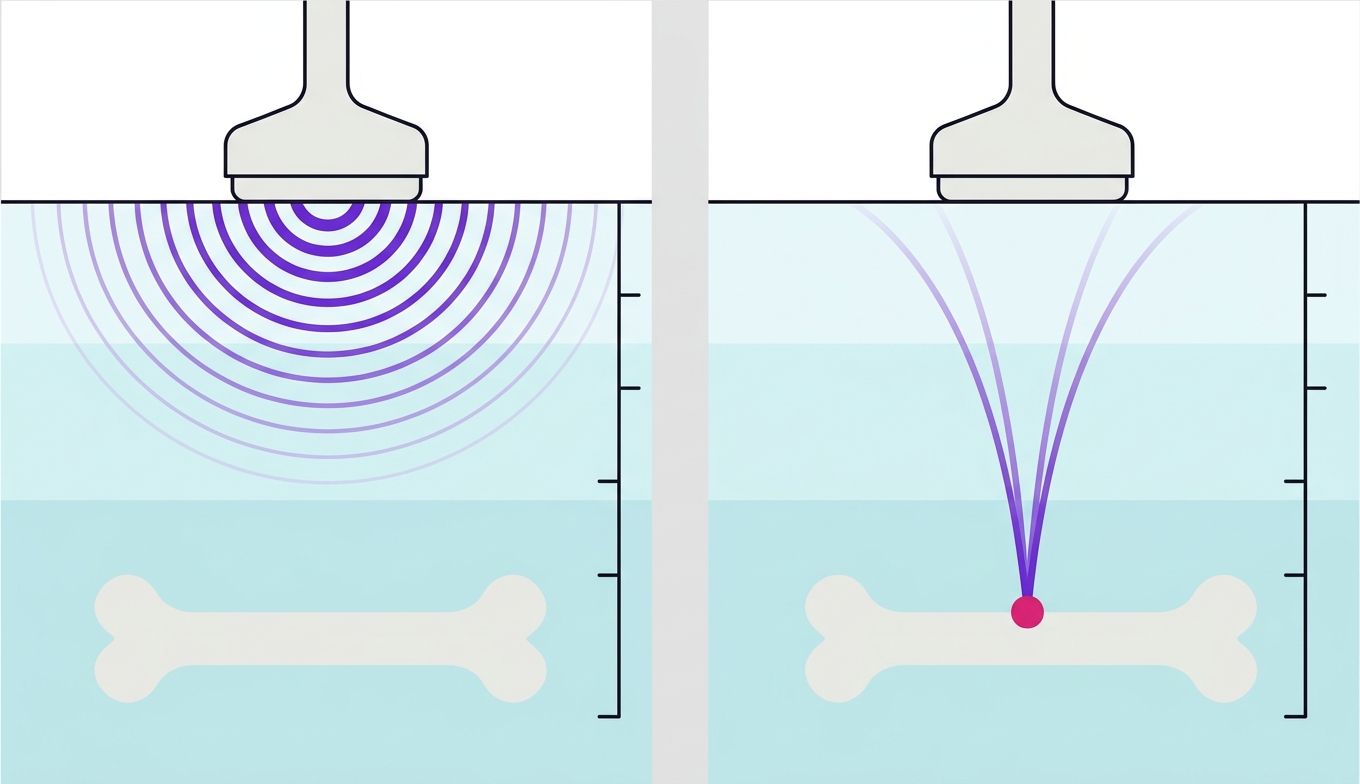
Radial peaks at the applicator and fades with depth; focused converges its energy at a point deep in the tissue.
| Property | Radial | Focused |
|---|---|---|
| Energy peak | At the applicator | At a focal depth in tissue |
| Typical working depth | About 3 to 4cm | About 10 to 12cm |
| Measured in | bar (pressure) | mJ/mm² (energy flux density) |
| Generation | Pneumatic, ballistic | Electrohydraulic, electromagnetic, piezoelectric |
| Best suited to | Superficial soft tissue, large treatment areas | Deep or precisely located targets, bone |
| Typical clinic | Most physiotherapy practices | Specialist MSK, sports medicine, secondary care |
What generates the wave?
Four mechanisms, and the one you buy determines your consumable bill for the next decade.
Pneumatic or ballistic (radial). A compressed-air projectile strikes a transmitter, which passes the wave into tissue. Mechanically simple, relatively cheap, and it wears: the projectile and guide tube are consumable parts.
Electrohydraulic (focused). A spark discharge in fluid creates a shockwave that a reflector focuses. High energy, and the electrode is a consumable with a defined life.
Electromagnetic (focused). A coil drives a membrane or cylinder, and a lens or reflector focuses the wave. More consistent output shot to shot, generally longer service life than electrohydraulic.
Piezoelectric (focused). An array of crystals fires simultaneously, converging on a small, very precisely defined focal zone. The longest-lived and usually the dearest.
If you are comparing a pneumatic unit against a piezoelectric one on headline price alone, you are comparing two things with different lifetime costs.
What do the energy numbers mean?
Energy flux density, in millijoules per square millimetre, is the figure that matters on a focused device. It sorts into three bands.
| Band | Energy flux density | Typically used for |
|---|---|---|
| Low | Under 0.08 mJ/mm² | Tendinopathy, spasticity |
| Medium | 0.08 to 0.28 mJ/mm² | Tendinopathy, soft tissue healing |
| High | Above 0.29, up to about 0.60 mJ/mm² | Calcific tendinopathy, bone disorders |
Higher energies are associated with benefit in calcific tendinopathy and bone conditions. Lower and medium energies are associated with promoting healing in tendinopathy and with spasticity management.
On radial devices the equivalent control is pressure in bar, plus frequency in impulses per second and total impulses per treatment. Those three settings, not the badge on the machine, are your dose.
Typical protocol: three to five sessions, at roughly weekly intervals, with anaesthesia not recommended. Local anaesthesia is specifically avoided because it appears to reduce effect.
What does NICE actually say?
This is the section the supplier will not open with, and it should shape both your consent process and your advertising.
NICE's guidance on extracorporeal shockwave therapy for refractory plantar fasciitis (IPG311, since migrated to HTG200) concludes that the evidence raises no major safety concerns, but that evidence on efficacy is inconsistent. On that basis the procedure should be used only with special arrangements for clinical governance, consent and audit or research.
NICE reached materially the same conclusion for refractory Achilles tendinopathy and for refractory tennis elbow.
Three things follow.
Your consent conversation has to carry it. NICE expects clinicians to ensure patients understand the uncertainty about efficacy, and to give them clear written information. A consent form that does not mention inconsistent evidence is not doing its job.
Your marketing has to carry it too. Advertising claims of efficacy need substantiation, and "NICE says the evidence is inconsistent" is a difficult starting point for a strong claim. The same substantiation test applies whatever your profession.
Audit is part of the arrangement. Record outcomes. Aside from being what NICE asks for, it is the only way you will ever know whether the machine was worth buying.
None of this means do not offer it. It means offer it honestly, and expect to say "the evidence is mixed" out loud to patients who ask.
Where is the evidence strongest?
Evidence supports use in calcific tendinopathy, plantar fasciitis, lateral epicondylosis, bone stress injuries, nonunion fractures, osteonecrosis and spasticity management. Strength varies considerably between those, and calcific tendinopathy and bone conditions are generally where high-energy focused therapy has the firmer case.
Contraindications. Absolute: active infection, malignancy in the treatment field for focused therapy, and pregnancy. Relative, for high-energy treatment: focusing over brain or nerve tissue, over lung or pleura, significant coagulopathy, and epiphyseal plates.
That last one matters if you treat adolescents, which in sports physiotherapy you will.
What does a machine cost?
Honest answer: the spread is enormous and published figures come mostly from manufacturers.
Indicative bands, converted approximately from manufacturer material quoted in US dollars, and worth treating as orientation rather than quotation:
| Category | Indicative cost |
|---|---|
| Entry-level portable radial | Low thousands |
| Mid-range clinical radial | Roughly £8,000 to £15,000 |
| Focused systems | £20,000 upwards, well into five figures |
| Combined radial and focused | Highest |
List prices are almost always negotiable, particularly near a manufacturer's quarter end, and particularly if you ask what happens to the price without the training package you may not need.
The two costs that are not in the quote
One: consumables are real, whatever the brochure says.
"No consumables" is a claim worth testing, because the moving parts wear on a defined schedule.
| Part | Typical life | Indicative cost |
|---|---|---|
| Revision kit, projectile and guide tube | 1 to 2 million shots | Roughly £120 to £480 |
| Radial handpiece, before rebuild | 200,000 to 1,000,000 shots | Varies widely |
| Focused or piezoelectric transducer | 3 to 5 million shots | Higher, but far less often |
| Whole handpiece refurbishment | Every 3 to 5 years | Ask, in writing |
At roughly 2,000 shots a session, a million shots is about 500 sessions. So a revision kit spread across its life is pennies per session. The handpiece rebuild every three to five years is the one that bites, and on air-driven units the O-rings and seals degrade whether or not you are busy. A high-traffic radial clinic should budget replacement parts every six to twelve months.
A well-built machine serves roughly 7 to 12 years with proper care. If your payback period is longer than your handpiece interval, the real payback is worse than your spreadsheet says.
Two: if your practice is VAT exempt, the VAT on the machine is a cost, not a reclaim.
This is the one almost nobody models. Most physiotherapy provided by a registered practitioner is exempt from VAT, and an exempt business generally cannot recover input VAT. So a £12,000 machine is a £14,400 machine, and the same applies to the service contract and the consumables.
That is a fifth added to the largest line in the calculation. Check your own position first, because it varies with what your practice actually supplies. Our guide to VAT exemption across allied health sets out how the test works.
Work out your own payback
Supplier calculators model the full session fee. That is only honest if the slot would otherwise have sat empty.
If your diary is busy, the slot would have held a standard appointment, so shockwave earns you the difference between its fee and your normal fee, not the whole fee. At £65 against a £63 follow-up that difference is £2, and no machine pays for itself at £2 a session.
Work out your own payback
The two costs the supplier's calculator leaves out: the slot it displaces, and VAT you can't reclaim.
Earns per session
£27
Per week
£162
Upfront cost
£15,600
Pays back in about 33 months
Workable, but watch the handpiece. Rebuilds land every three to five years, so a payback near three years means the first big service bill arrives before you have cleared the machine.
12 months
−£9,948
24 months
−£4,296
36 months
+£1,356
Contribution assumes 46 working weeks a year. Orientation only — confirm consumable and service costs with the supplier in writing, and check your own VAT position. Nothing you type is stored or sent anywhere.
UK session prices run roughly £60 to £250, with most clinics between £60 and £150 and London at the top. Packages of four to six sessions are standard, which matches the three-to-five-session protocol.
The conclusion most people reach when they model it properly: shockwave has to be priced as a premium service, or it does not pay. Our guide to which add-on services actually pay applies the same test across the other modalities.
The checklist to take to the supplier
Print this. Ask all of it, and get the answers in writing rather than in a demonstration.
The machine
- Is it radial, focused, or both, and what is the working depth in centimetres?
- What is the energy range, in bar for radial or mJ/mm² for focused?
- Which transmitter or applicator heads are included, in what sizes, and what does each additional one cost?
- Is it UKCA or CE marked, and who is the UK responsible person?
- Is there a shot counter, and can I see it?
- Is the device shot-licensed? Some are sold with a shot allocation that must be topped up. Ask directly, because this changes the economics entirely.
Consumables and wear
- What is the handpiece life in shots, not in years?
- What does a revision kit cost, and how many shots does it last?
- How often does the whole handpiece need refurbishing or replacing?
- Is the handpiece covered by the warranty, or excluded as a consumable? It is very often excluded, and it is the part that wears.
- What does the machine consume in gel per session?
Warranty and service
- How long is the warranty, and what exactly is excluded?
- What does a service contract cost per year after the warranty ends?
- What is the guaranteed response time for a breakdown?
- Do you provide a loan unit while mine is being repaired, and is that in the contract or a favour?
- Is annual calibration required, who does it, and what does it cost?
- Are software updates included for the life of the device?
Training and support
- How many staff does the included training cover, and what happens when one of them leaves?
- Is refresher or advanced training included or chargeable?
- Is there clinical protocol support, and is it from a clinician or a salesperson?
Commercial
- What is the price including VAT, and if I cannot reclaim it, what is the real cost to me?
- If financed: is it a lease or hire purchase, what is the APR, what is the total amount payable, and who owns the machine at the end?
- Is there a trade-in or buy-back?
- Will you place a unit in my clinic on trial before I commit?
- Can I speak to three UK clinics of my size who bought this model more than two years ago?
That last question is the most useful on the list. A supplier confident in the machine will find you three names. One that cannot is telling you something.
So should you buy one?
A defensible summary.
Buy if you have a genuine caseload of the conditions where evidence is strongest, you can price it as a premium service well above your standard fee, you have diary capacity to fill, and you are comfortable explaining inconsistent evidence to patients.
Do not buy if the plan is to charge your normal fee for it, the diary is already full at that fee, or the business case depends on a supplier's payback calculator.
Think harder if your practice is VAT exempt, which quietly adds a fifth to the cost, or if the payback runs past three years, at which point handpiece replacement lands before you have cleared the machine.
The machine is rarely the mistake. The pricing usually is.
This is general commercial and technical information, not clinical or investment advice, and it is not a substitute for the device instructions for use. Cost bands are indicative, drawn from manufacturer material largely quoted in US dollars, and UK prices vary widely. Consumable lives and service terms differ by manufacturer and must be confirmed in writing. Clinical parameters and contraindications are summarised from a peer-reviewed best-practice review and should be checked against current guidance and your own training before treating. VAT treatment depends on your own supplies; take advice.
Sources: Best practices for extracorporeal shockwave therapy in musculoskeletal medicine (PMC9321712) · NICE, extracorporeal shockwave therapy for refractory plantar fasciitis · NICE HTG200.