 Atlacare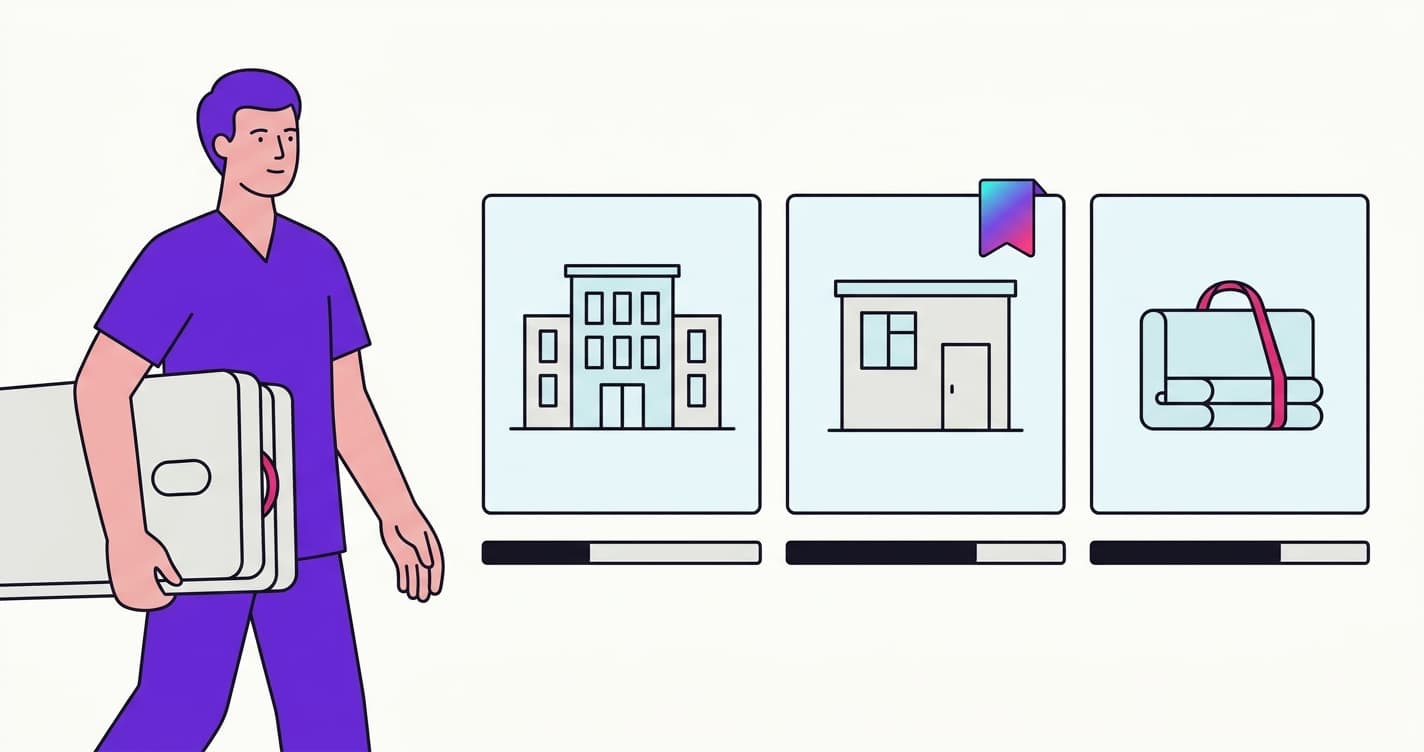
Renting a treatment room can trigger a local authority licence costing several hundred pounds a year. Going mobile, visiting clients in their own homes, generally does not. That regulatory difference is missing from every comparison of these three models, and in some boroughs it is larger than the rent difference.
Here are the actual numbers on all three, and the cost most people leave out.
The three models
Employment at a spa or clinic. A salary or an hourly rate, no overheads, no client acquisition, and no control over pricing. Reported earnings for employed massage therapists commonly sit in the region of £18,000 to £25,000, though these figures come from salary aggregators and recruitment content rather than survey data, so treat them as indicative.
Renting a room. You keep your fees and pay for the space. Higher ceiling, real fixed costs, and you find your own clients.
Going mobile. You travel to the client. No rent at all, but travel eats billable time and you can only serve people who want a home visit.
What does a room actually cost?
Regional rent data published in May 2026 by a therapy room listings platform, derived from active listings:
| Location | Hourly | Notes |
|---|---|---|
| Central London, zones 1 to 2 | £25 to £60 | |
| Outer London and commuter belt | £18 to £35 | |
| Major regional cities | £15 to £30 | Bristol, Manchester, Leeds, Birmingham |
| Smaller towns | £10 to £20 |
Day rates commonly run £80 to £250, and monthly licences £300 to £1,500.
The important arithmetic is not the hourly rate. It is what happens to an unfilled hour. Book eight hours and fill five, and your effective rent per treatment is 60% higher than the advertised figure. Hourly rental protects you from that. A fixed monthly licence does not, which is why monthly deals are cheaper per hour and worse when you are quiet.
The cost nobody includes
Here is where the three models genuinely diverge, and it is not in the rent.
In parts of the UK, providing massage from premises requires a local authority licence. These run on private local Acts rather than national law, so whether you need one depends entirely on your postcode. Verified examples: Ealing charges £499 for a new licence or renewal, plus £93.11 for a variation. Bromley charges £306 for an annual renewal.
A mobile therapist visiting clients at home generally does not need one. Bromley states this explicitly. So the same treatment, delivered by the same person with the same qualification, is licensable in a rented room and unlicensable in a client's living room.
Our guide to special treatment licences sets out the position across all four nations, including the change in Wales that made unlicensed practice a criminal offence there. Check your own council before you sign a room agreement, because in some areas this adds several hundred pounds a year to the room option and nothing at all to the mobile one.
Running the comparison properly
Take a therapist charging £55 a treatment, working 20 treatments a week, 46 weeks a year. That is £50,600 of gross fees before anything.
Employed: you do not see that figure. You see a salary, and the spa keeps the difference in exchange for the room, the marketing, the booking system and the risk.
Room rental at £20 an hour, 25 hours a week: £23,000 a year in rent, plus a licence where required, plus insurance, plus your own marketing. If you fill 20 of those 25 hours you are paying £1,150 per unfilled slot over the year.
Mobile: no rent, no licence, but perhaps 90 minutes of travel for every two treatments, which is billable time you are not billing. At 20 treatments a week that is roughly 15 unpaid hours, which is most of a working day.
None of the three is obviously best. The employed option trades income for certainty. The room trades fixed cost for capacity. Mobile trades travel time for zero overhead.
Which suits which stage?
Starting out: mobile, or hourly room rental. Both let you be wrong about demand without it costing much. A monthly licence signed before you have a client base is the classic early mistake.
Established with a full diary: a fixed monthly room is usually cheaper per treatment, and the predictability is worth something.
Wanting to grow beyond yourself: the room is the only one of the three that scales, because you cannot employ anyone into a mobile round or a spa chair.
Wanting reliable income without admin: employment is not a failure state. It is a different trade, and for some people the right one.
Two things to do before you decide
Check your council's licensing position. It takes ten minutes and it can change the maths by hundreds of pounds a year.
Model your actual fill rate, not your hoped-for one. Rent is charged on the hours you book, not the hours you work. Most people who lose money on a room lose it in unfilled slots rather than in the rate.
And whichever model you choose, keep the booking and the records in one place rather than spread across a phone, a paper diary and a spa's system you cannot export from. Practitioners moving between these models most often lose their client history at the transition, which is the one asset that carries across all three. Atlacare has a free plan that covers a solo caseload, which at least means the records are yours from the start.
Rent figures are drawn from a published regional analysis of active listings and are indicative rather than a survey. Salary figures come from aggregator and recruitment sources. Licence fees are as published by the named councils and vary considerably by area. Check your own council before relying on any figure here.
Sources: regional therapy room rental analysis, May 2026 · Ealing Council, massage and special treatment licences · Bromley Council, special treatment licence
Related: Do I need a special treatment licence? · Dealing with inappropriate client behaviour · What it costs to set up a private practice in year one