 Atlacare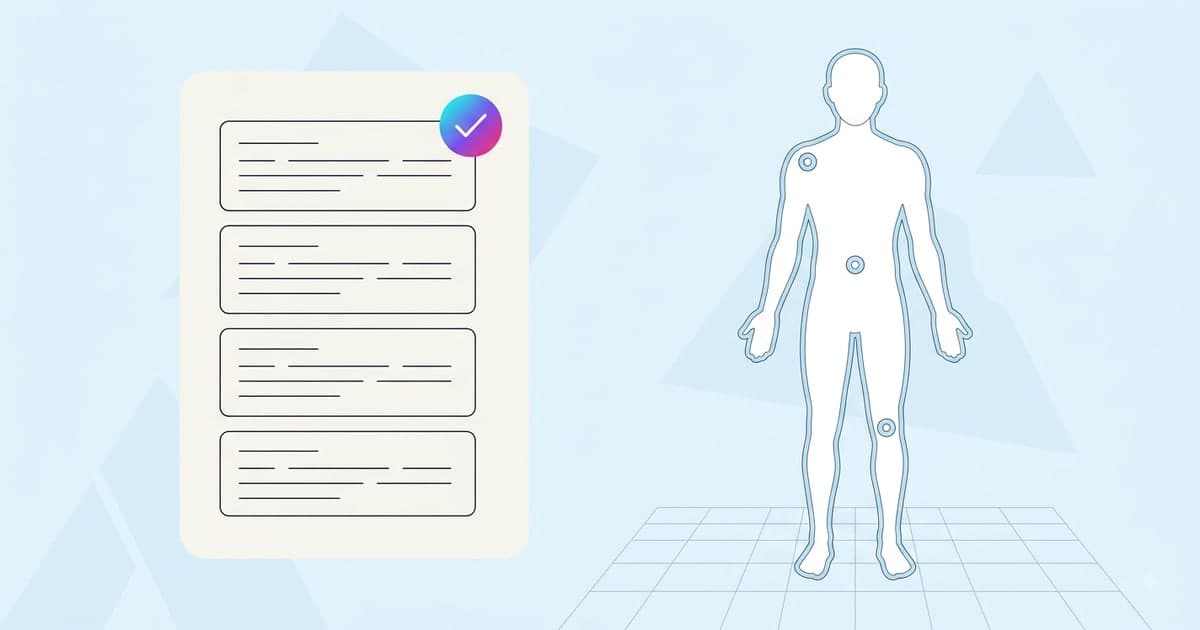
Most software comparisons for osteopaths are feature lists with the word "osteopathy" swapped in. They rarely start where an osteopath's actual obligations start, which is with the General Osteopathic Council.
You must be GOsC-registered to practise osteopathy in the UK, and the Osteopathic Practice Standards set out what your records have to contain. Any software decision is downstream of that. So this guide works from the standards outwards, rather than from a feature grid inwards.
What do GOsC standards require of osteopathic records?
The Osteopathic Practice Standards require contemporaneous records covering, for every patient interaction:
- Case history
- Examination findings
- The treatment provided
- Informed consent
Two words in that list do most of the work.
Contemporaneous means written at the time, not reconstructed on Sunday evening. Software either makes that realistic between patients or it does not, and that is a usability question rather than a features question.
Informed consent is where osteopathy differs sharply from most allied health disciplines. Consent for manual therapy, and particularly for any high-velocity technique, is a documented event with its own significance, not a signature collected once at registration. Your system needs somewhere consistent for it to live, and it needs to be findable years later.
What should an osteopath look for in practice software?
Note structure that fits how osteopaths work
SOAP is the documentation norm in osteopathy, so a system that ships with SOAP already configured saves you building it.
Watch for software that gives you a blank template builder and calls it flexibility. Flexibility is genuinely useful once you know what you want; on day one it is an hour of work before your first patient, and a structure you invented under time pressure and will live with for years.
Atlacare ships with SOAP configured for osteopathy out of the box, as one of 17 professions with their own note fields and tools. Osteopaths get SOAP, psychologists get DAP, counsellors get BIRP, without anyone building a template.
A body chart you would actually use
Osteopaths draw. A system that expects you to describe restriction and tenderness in prose is fighting the way the profession thinks.
The thing to check is whether the body chart is a real anatomical image with markers you place, or a decorative outline. Atlacare's is a front and back anatomical chart with markers for pain, tenderness, numbness and referred symptoms, each carrying a severity, stored against the note so you can compare across a course of treatment.
Consent capture that is part of the record
Given the standards, this deserves more weight than it usually gets in comparisons.
You want consent forms a patient can complete before they arrive, stored against their record rather than in a filing cabinet or an email folder. Atlacare includes a library of 16 ready-made forms covering intake, consent and screening, completed through the patient portal and attached to the patient. Our guide to what consent to document before spinal manipulation covers the clinical side.
Record visibility, because osteopathy is often a shared building
Many osteopaths work in multidisciplinary clinics, renting a room alongside physios, podiatrists and massage therapists. If you share a system, you need to know what your colleagues can see.
Three tiers is the sensible minimum: notes the patient can see in their portal, notes all clinical staff can see, and confidential notes restricted to the treating practitioner and the practice owner. Atlacare enforces exactly that and applies it everywhere, including the portal.
Retention you do not have to remember
Osteopathic records have retention periods, and the deletion step is the one humans reliably fail at, because it falls due years after anyone is thinking about that patient.
A system that tracks last-contact dates and applies a retention rule does the part of compliance that is genuinely hard to do manually. Our guide to record retention has the periods.
Getting your existing patients in
Whatever you choose, the migration is the bit that stops people. If you are on Cliniko, Jane, WriteUpp, Carepatron or Pabau, Atlacare's import wizard has presets for each: export your patients, drop the file in, and it maps the columns, matches practitioners fuzzily so "A. Rahman" and "Aisha Rahman" resolve to one person, and records GDPR consent status honestly rather than marking everyone consented. Coming from paper, our paper-to-digital guide covers the sequence.
What is not worth paying extra for?
A short honest list, because the category is full of things sold as essential.
Exercise prescription libraries are useful if you prescribe a lot and irrelevant if you do not. Judge on whether you will actually use it.
Integrated marketing suites rarely outperform a well-kept Google Business Profile and a habit of asking for reviews. The Private Practice Barometer 2026, a survey of 715 UK clinic owners, puts median cost per patient acquisition at £25, which is a low bar for any software to beat.
Anything that requires a demo call before it will tell you the price. You can judge that one yourself.
What Atlacare does not do yet
Since this is our own guide, the honest column matters more than the flattering one.
- Video consultations are foundation only. The provider integration and room model exist; the join flow, telehealth consent and patient emails are not finished. Do not choose us for telehealth today
- Online card payments are not live end to end. You can create and send invoices with PDFs; collecting payment through the system is not finished
- Accounting sync with Xero, QuickBooks and Sage is planned, not built
- We are new. Fewer integrations, no years of community forum answers, a smaller ecosystem than the established names
Where we are strong is the thing this article started with: profession-configured notes, a real body chart, consent forms, strict visibility rules, EU data residency and GDPR handling that was in the schema from the first version rather than added later.
The osteopathy numbers, for context
From the same Barometer survey, useful when you are deciding what software is worth:
- Osteopathy median fees: £70 initial, £55 follow-up (n=64)
- Across all disciplines, median profit margin is about 20%, and average diary utilisation 72.3%
- Median rebooking rate is 80%, with the top 10% of clinics above 90%
At a £55 follow-up, a software subscription of £25 a month costs you less than half a session. The question is not whether you can afford practice management software. It is whether the one you choose gets you to the top decile on rebooking, because that is worth several thousand pounds a year and no software licence costs that.
How do I choose software in an afternoon?
- Write down your obligations first. Case history, examination findings, treatment, consent, contemporaneous, retained for the required period
- Ask each product to show you a completed osteopathic note, not a dashboard
- Check the body chart is real, and that markers persist across notes
- Ask where consent forms live and how you would find one from four years ago
- Ask where the data is stored, and get the sub-processor list in writing
- Ask how you get your data out, before you put any in
- Try it with ten real patients before migrating everything
Most products survive the first three questions. Rather fewer survive the last three, and those are the ones that matter when you leave.
Sources: General Osteopathic Council Osteopathic Practice Standards. UK Private Practice Barometer 2026 (HMDG, 715 UK clinic owners, August to November 2025), self-reported. Atlacare feature status is accurate at the review date above.
Related: Moving from paper records to digital · How long must you keep patient records? · UK GDPR for practitioners